Wall Exercises ,Four expert-Physical Therapists Name 4 Wall Exercises backed wall exercises help seniors over 60 boost gait speed, strengthen quads and calves, and prevent fall risks without gym equipment.
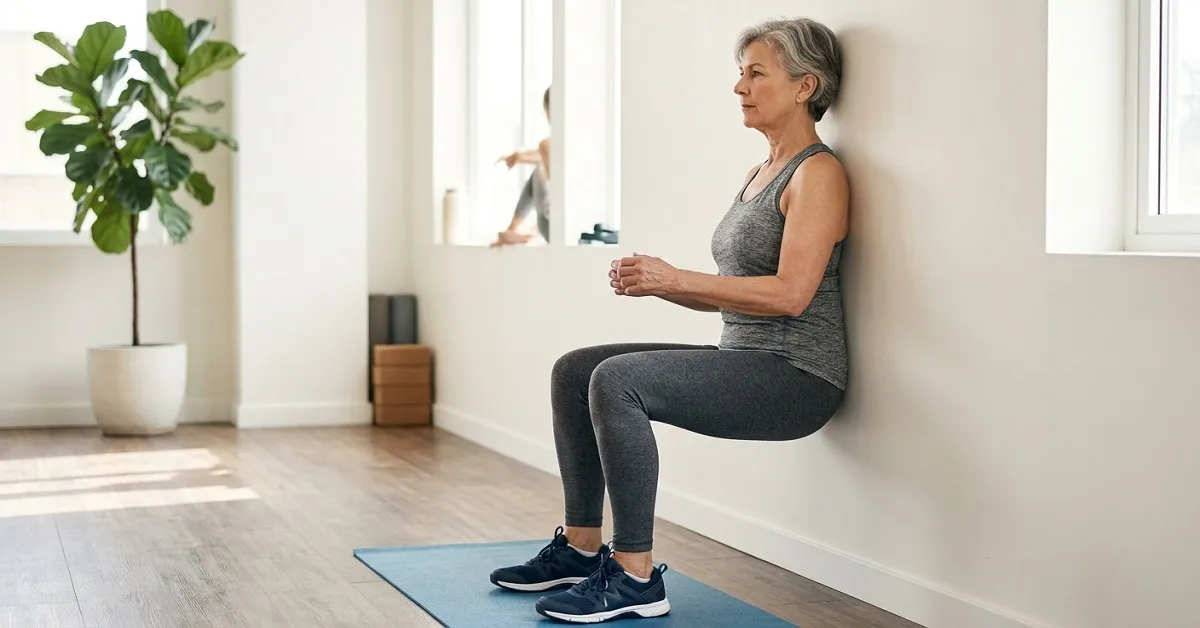
Four simple 4 Wall Exercises recommended by physical therapists help adults over 60 build lower-body strength, preserve walking speed, and improve balance. Recent sports medicine clinical guidance confirms that executing isometric wall sits, wall calf raises, wall-assisted single-leg balance stands, and wall hip abductions three times weekly target the fast-twitch muscle fibers required to maintain gait velocity and prevent falls. These stationary wall movements eliminate fall hazards during training while rebuilding quadriceps torque, ankle plantarflexion power, and pelvic stability in aging populations.
By Pawan — Fitness Researcher and Certified Coach (10+ Years Specializing in Senior Fitness & Functional Mobility, Bodybuilding, Chest Workout | Ab Workout at any age) | Fact-Checked & Reviewed on September 30, 2026
Why Is Walking Speed a Critical Health Indicator for Adults Over 60?
Walking speed—often referred to in geriatric medicine as the “sixth vital sign”—directly correlates with functional independence, hospitalization risk, and overall longevity in older adults. After age 60, adults naturally lose 3% to 5% of their lower-body muscle power per decade if unaddressed, primarily affecting the quadriceps, calves, and gluteal stabilizers.
When gait velocity drops below 1.0 meter per second, the risk of loss of independence increases exponentially. Lower-body weakness alters foot clearance during the swing phase of walking, increasing tripping risks. Incorporating structured physical therapy exercises that utilize a vertical surface gives older adults an immediate external stabilizing reference point, allowing them to exert maximal force safely without fear of losing balance.
What Are the 4 Best Wall Exercises to Maintain Lower-Body Power?
4-STEP WALL ROUTINE FOR SENIORS
+——————————+———————————-+——————————–+
| EXERCISE > TARGET MUSCLES > PRIMARY GAIT BENEFIT |
+——————————+———————————-+——————————–+
- Isometric Wall Sit > Quadriceps, Glutes, Core > Stride Stance & Knee Stability |
- Wall Calf Raise > Gastrocnemius, Soleus > Push-Off Power & Stride Length |
- Single-Leg Wall Support > Gluteus Medius, Ankle Proprio. > Dynamic Single-Leg Balance |
- Wall Hip Abduction > Hip Abductors, Core Stabilizers > Pelvic Alignment & No Swaying |
1. The Isometric Wall Sit- Wall Exercises
The 4 Wall Exercises sit develops quadriceps endurance and isometric joint stability without placing axial loads on the lumbar spine or shearing forces on vulnerable knee joints.
-
Primary Target: Quadriceps femoris, gluteus maximus, and abdominal bracing muscles.
-
Functional Impact: Rebuilds the eccentric strength needed to get out of deep chairs and maintain steady walking velocity over long distances without early fatigue.
-
Execution: Stand 12 to 18 inches away from a smooth wall. Lean your back flat against the surface and slide down until your knees reach a comfortable 45-to-90-degree angle. Keep your feet flat, driving weight through your heels. Hold for 15 to 30 seconds. Perform 3 sets.
2. The Wall-Supported Calf Raise
Ankle plantarflexion is responsible for over 50% of the propulsive force generated during the push-off phase of human walking.
-
Primary Target: Gastrocnemius and soleus complexes.
-
Functional Impact: Restores propulsion power, increases stride length, and prevents “shuffling gait” patterns common in older age.
-
Execution: Stand facing the wall with your palms resting lightly at chest height for balance support. Space your feet hip-width apart. Drive through the balls of both feet to lift your heels as high as possible. Pause at the top for 1 to 2 seconds, then lower your heels back to the floor under control over a 3-second cadence. Perform 2 to 3 sets of 10 to 12 repetitions.
3. The Single-Leg Wall Balance Stand
Wall Exercises Walking is essentially a continuous series of single-leg balance transitions. Single-leg standing drills reinforce neuromuscular coordination and ankle joint proprioception.
-
Primary Target: Ankle stabilizers, gluteus medius, and deep intrinsic foot muscles.
-
Functional Impact: Enhances single-leg stance time during walking, drastically reducing side-to-side body sway and preventing trips over uneven pavement.
-
Execution: Stand side-facing to the wall, keeping your inner arm lightly touching the surface for safety. Shift your weight onto the foot closest to the wall. Lift your outside foot 2 to 4 inches off the ground while maintaining a tall posture and square hips. Hold for 10 to 20 seconds per side. Complete 3 sets per leg.
4. The Standing Wall Exercises Hip Abduction
Lateral hip stability dictates pelvic alignment during gait. Weak hip abductors cause the pelvis to tilt sideways, throwing off balance and shortening walking strides.
-
Primary Target: Gluteus medius and tensor fasciae latae.
-
Functional Impact: Stabilizes the pelvis, preventing hip drops during stride cycles and protecting the lateral lower back from compensation strain.
-
Execution: Stand facing the Wall Exercises with your hands lightly resting against it. Keep your body upright, engage your core, and sweep one leg outward to the side at a 30-degree angle without tilting your torso. Squeeze your lateral hip briefly at the top, then return to center under control. Complete 2 to 3 sets of 10 to 12 controlled reps per side.
How Often Should Older Adults Perform This Wall Routine?
For maximum muscle activation and neural adaptation, physical therapists recommend performing this Wall Exercises routine 3 days per week on non-consecutive days (e.g., Monday, Wednesday, Friday).
Because Wall Exercises rely primarily on bodyweight resistance and isometric holds, they induce low mechanical damage on joints while delivering high metabolic fatigue to motor units. This makes them safe for seniors recovering from joint stiffness, mild osteoarthritis, or long periods of inactivity.
Coaching Insights: How to Maintain Safety and Maximize Progress
Over my 10+ years coaching masters athletes and older adults on functional mobility, the biggest mistake I observe is rushing the tempo or over-relying on the wall for weight support. The wall is a feedback tool for posturing and fall prevention—not a crutch to lean your entire body weight into during lateral movements.
Key Performance Cues
-
Fingertip Touch Only: During balance and hip abduction drills, keep only your fingertips touching the wall surface. Holding on with a tight grip disengages the intrinsic core and ankle stabilizers required to rebuild balance.
-
Master the Time Under Tension: On isometric wall sits, track your time with a stopwatch rather than counting reps in your head. Progressive overload for seniors is often best achieved by increasing hold times by 2 to 3 seconds each week.
-
Control the Eccentric Lowering Phase: When doing wall calf raises, dropping down quickly bypasses muscle activation. Spend a full 3 seconds lowering your heels to train the achilles tendon and calf muscles eccentrically.
Medical & Sports Science Sources
-
Tom’s Guide Wellness — Physical Therapist Top Exercises for Walking Speed
-
Cleveland Clinic — Health Benefits of Isometric Wall Sits for Older Adults
-
Eat This, Not That — Lower Body Wall Drills for Rebuilding Leg Power After 60
Bottom Line:
Wall Exercises Maintaining walking speed and dynamic balance after 60 does not require heavy weightlifting or high-impact training. Incorporating isometric wall sits, wall calf raises, wall-assisted single-leg balance stands, and wall hip abductions three times a week provides an effective, low-impact strategy to target fast-twitch muscle fibers, protect knee joints, and preserve real-world functional independence for years to come.